Vest stitching: what the seams reveal about craftsmanship
How to read a vest's stitching to judge craftsmanship: shoulders, armholes, lapels, topstitching and buttonholes. A self-check list from Mon Amie.
To tell whether a jacket was made with care, look at the stitching in five places: the shoulder, the armhole, the lapel, the topstitching and the buttonholes. Handsome cloth can make a jacket look fine on the hanger, but the seams show how long it will hold its shape through repeated wear. Here is how to check each area, for use both at sample approval and on delivery.
Shoulder and armhole: where skill shows first
Stand in front of a mirror in the jacket, raise your arm and lower it again. It is a simple test that reveals a lot.
- Shoulder seam: it sits on the point of the shoulder, the surface is flat, with no ripples or raised ridge. A diagonal crease running from collar to shoulder usually means the shoulder does not suit the body.
- Armhole: the sleeve is set in a smooth, even circle. Reaching forward should move the body of the jacket only slightly, not drag it sideways.
- Sleeve hang: the sleeve turns gently forward with the arm and does not twist.
- Back: the centre seam runs straight, and no horizontal crease appears just below the collar or at the waist when you stand upright. Ask someone to photograph the back so you can see it properly.
Lapel, collar and the hidden canvas
The lapel should be flat, follow the chest and roll naturally along its fold, without lifting at the edge. The collar sits against the shirt collar with no gap at the back of the neck.
The interlining inside is hard to see yet decides long-term shape. Two common approaches are fused and sewn-in construction; each has trade-offs depending on the cloth and the way it is made. At sample approval, ask the maker which type is used and where, then feel the chest area for stiffness or collapse.
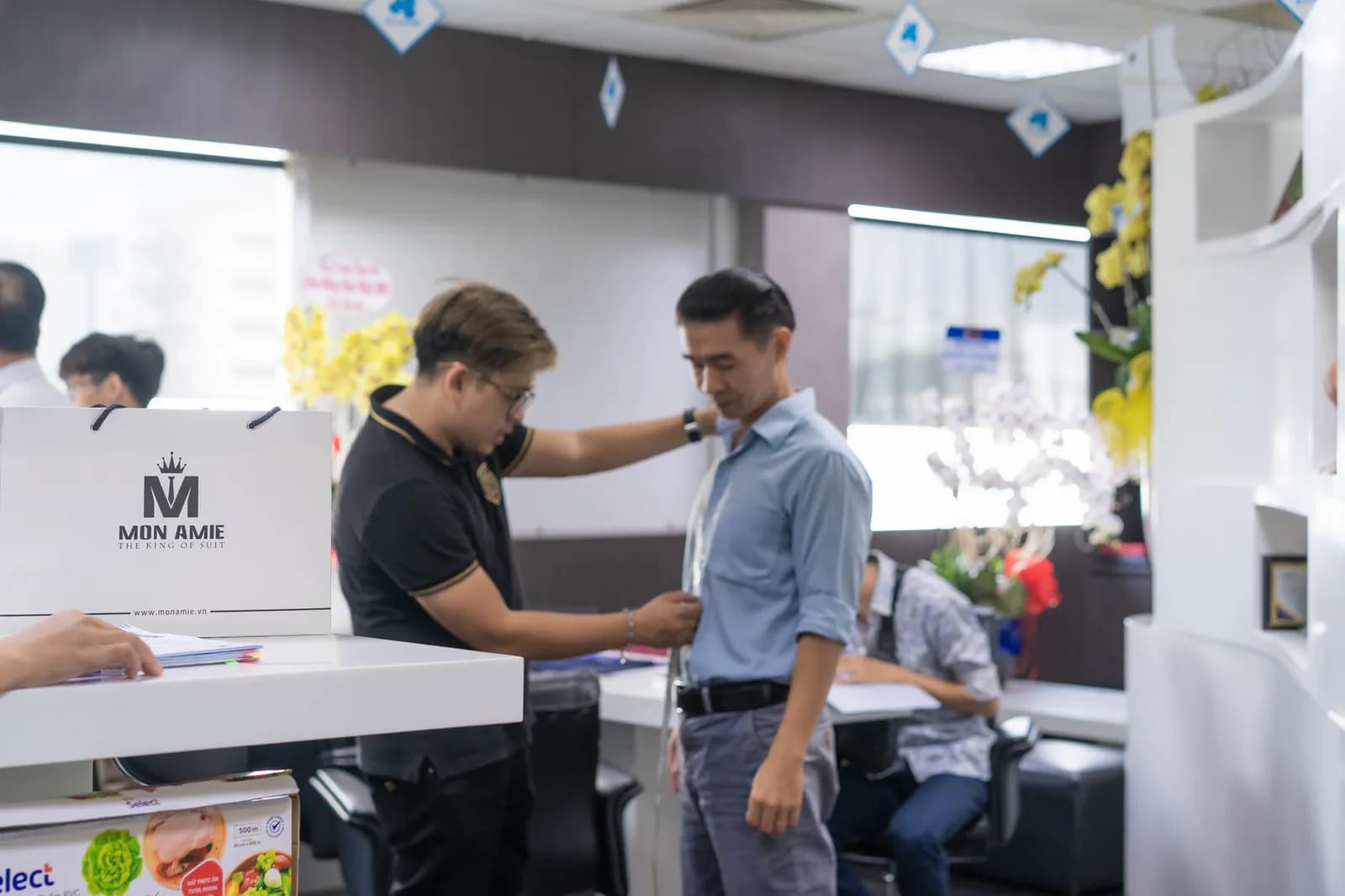
Below is a photograph from a Mon Amie Uniform project.

Topstitching, buttonholes and pattern: a quick-reference table
| Area | Sign of careful work | Sign to question |
|---|---|---|
| Topstitching | Even stitches, straight, evenly set from the edge | Stitch length varying, wavy lines |
| Buttonholes | Clean edges, no frayed thread, button fits the hole | Frayed thread, a loose hole that lets the button slip |
| Stripes and checks | Pattern matches at pocket flaps, centre back and lapel | Stripes break at the pocket flap or seams |
| Pockets | Flat flaps, closed mouths | Gaping mouths, curled flaps |
| Lining | Neat lining seams, no raw edges | Puckered lining, pulling when you reach |
Reading it is straightforward: if all five rows look right, you can be confident in the workmanship. A single row off is not necessarily serious, but it deserves a question about the cause.
Three stages of a jacket
Hoàng Vy – Mon Amie was founded in 1991 and has a 1,000 m² workshop on 3/2 Street with more than 80 skilled tailors. Every order passes quality checks at three stages: cutting, assembly and finishing. The same split is also the easiest way for a buyer to review a jacket: faults from cutting (mismatched stripes, short cloth), from assembly (rippled shoulder, twisted sleeve) and from finishing (shine from pressing, loose buttons, frayed buttonholes).
Beautiful stitching on a hanger is pointless if the measurements are wrong, which is why each person is measured individually at their office; see our on-site tailoring page. For striped or checked cloth, look at real swatches in our fabric library first; swatches are also shown at the design stage.
Using this list at sample approval and delivery
Mon Amie produces only after your company signs off the sample, so the sample is your last chance to review. A sensible order is:
- Wear the sample, raise your arms, sit and stand a few times.
- Check shoulder, armhole, lapel and collar as above.
- Turn the jacket inside out to examine the lining and internal seams.
- On delivery, compare the finished piece with the approved sample.
Garments are delivered to your site, then tried on and adjusted on the spot. Alterations are covered by a free 3-year warranty at every showroom. For a proposal for your company, send your details through the quote page or call 0888.111.118.
Frequently asked questions
How can I tell whether the shoulders fit correctly?
The shoulder seam sits on the point of the shoulder, the surface is flat, and the body of the jacket does not ride up when you lift your arm. A diagonal crease from the collar usually means the shoulder needs adjusting.
Does even topstitching mean the jacket will last?
Even topstitching signals steady workmanship, but durability also depends on the cloth, thread and interlining. Look at several areas together instead of one.
What if the sleeve twists on delivery?
A twisted sleeve can usually be corrected at the armhole. Mon Amie tries garments on and adjusts them on the spot at delivery, and alterations are covered by the free 3-year warranty at every showroom.
Are striped or checked jackets harder to make?
In workmanship, yes: the pattern must be matched at several points such as pockets and lapels. Real prices depend on fabric, style and quantity, so Mon Amie quotes specifics after the survey.