Checked suits in the workplace: choosing the right pattern
A checked suit works at the office when the check is small, low-contrast and matched at the seams. Here is which checks suit work and how to style them.
A checked suit works in an office when the check is small and low in contrast, the base is navy, grey or a deep brown, and the tailor has matched the lines across the seams. Very large checks or strong contrast can feel busy, which suits events or personal style better than a daily meeting.
Common checks and how well they suit work
Tailors use international names for checks, so you will meet them when looking at swatches:
| Check | Character | Office suitability |
|---|---|---|
| Micro check | Tiny squares that read almost as a plain colour with depth | Very suitable, safe for meetings and clients |
| Glen check (Prince of Wales) | Interlocking squares, usually grey or navy | Suitable with a clean cut and deep colours |
| Windowpane | Fine lines forming large, widely spaced squares | Suitable when lines are thin and low-contrast |
| Houndstooth | Bold, angular pattern | Better for waistcoats or jackets than a full suit |
| Large high-contrast check | Big squares in light and dark | Events, rarely everyday office wear |
Matching the check to build and setting
Large checks make a frame look broader, so smaller builds do better with small checks; taller wearers with broad shoulders can carry a slightly larger scale. Thin, low-contrast lines keep a serious tone, while thick, bright lines pull every eye to the jacket.
Look at the swatch under office lighting, not only by a window, because the check changes with the light source. Very fine checks can shimmer on a video-call camera, so if the suit will be used in online meetings, take a test photo first.
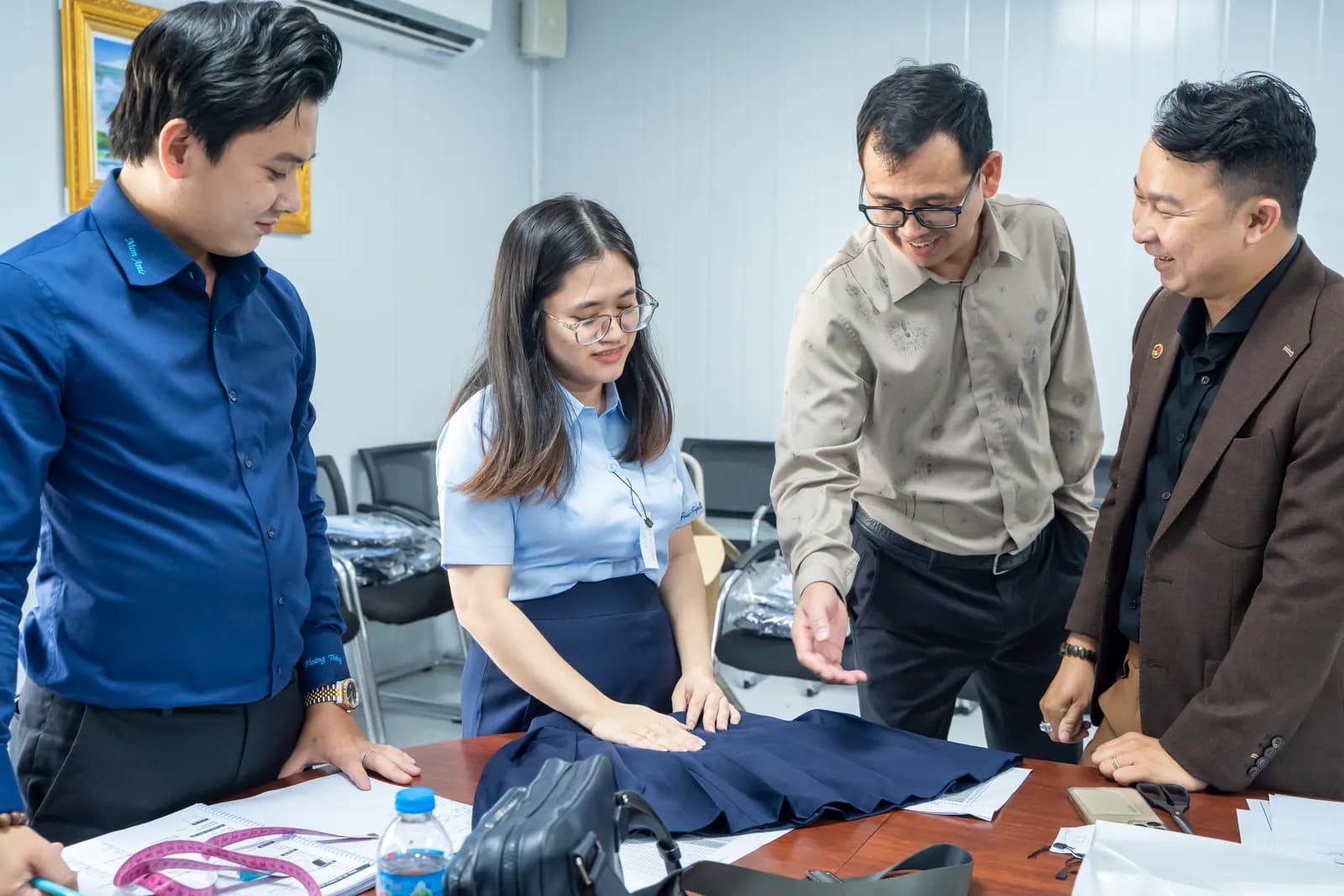
Mon Amie Uniform has worked with Công ty Cổ phần Cấp nước Thủ Đức, and the photo below shows one project with this organisation.

Pattern matching: the tailor's craft
What separates a well-made checked suit from a rushed one is whether the lines meet at the seams. At sample approval, check:
- Centre back: squares symmetrical on both sides.
- Pocket flaps and body: lines running through so the pocket seems to melt into the jacket.
- Collar and shoulders: the check not twisted against the body.
- Sleeves and underarm: sleeve lines aligned with the body where they join.
Matching takes careful planning at the cutting stage, and checked cloth usually needs more fabric than plain. Ask about the fabric code and whether it can be reordered later, so a second batch does not drift in tone.
Styling a checked suit
A simple rule is one bold pattern, everything else plain:
- Shirt: white, pale blue or cream, without small stripes that compete.
- Tie or scarf: plain, or a pattern at a different scale from the check.
- Trousers or skirt: plain in the same tone, or in the same cloth if sold as a set.
- Shoes and accessories: deep tones with few details to keep the whole look tidy.
When checks belong in a corporate uniform
Few companies dress an entire team in check, because the lines must be matched and the same check reads differently across sizes. More practical uses are:
- Waistcoats or skirts in a small check for a group such as front-of-house or consultants.
- A checked jacket for managers or executives, worn with the plain shirt and trousers of the team uniform.
- A single checked detail, such as a lining or tie, to keep identity without a full suit.
Mon Amie publishes starting prices: men's business suits from 3,000,000 VND, women's business suits from 1,500,000 VND and waistcoats from 600,000 VND, with a minimum of 5 sets for the suits and 5 for waistcoats. Real prices depend on fabric and style, and checked cloth may differ from plain, so we confirm the figure during consultation. Browse samples in our fabric library, and our team can measure each person at your office through on-site tailoring, with measurements stored under employee IDs for later batches.
Frequently asked questions
Is a checked suit suitable for everyday work?
Yes, if you choose a small check or a grey or navy glen check and pair it with a plain shirt and tie. Large, high-contrast checks are better kept for events or personal style.
Should I choose a small or large check?
A small check is safer at work and reads almost as a plain colour from a distance. A large check makes the frame look broader and can feel busy, so use it only when your build and the occasion both suit it.
Can a whole company wear check uniforms?
It is possible but uncommon, since lines must be matched and later batches must match earlier ones. A practical route is a check waistcoat, skirt or manager jacket, then discussing fabric codes with Mon Amie during consultation.
How do I know the check has been matched properly?
Try the sample on and look at the centre back, pocket flaps, collar and sleeve joins. If the lines meet there, the sample passes; sign off only after checking these points.
If you are considering a checked suit for a group of staff, submit your details on our quote page or call 0888.111.118 (the same number on Zalo) and Mon Amie will advise.