Suit uniforms for logistics: office, depot and dispatch
Suit uniforms for logistics firms suit office, sales and depot managers; warehouse and delivery crews need separate workwear. Men's suits from 3,000,000 VND.
Suit uniforms for a logistics company suit the office, sales, dispatch and depot-management teams, the people who meet customers and partners or move between the office and the yard. Warehouse and delivery crews usually need separate workwear such as polos or jackets that are hard-wearing and easy to launder. The approach that works is one company colour identity, applied in two layers for two kinds of work.
Who in a logistics company should wear a suit
| Role | Suggested outfit | Reason |
|---|---|---|
| Management and executives | Two-piece men's or women's suit, shirt, trousers or skirt | Represent the company with customers and partners |
| Sales, customer service, documentation | Suit jacket, or shirt with a waistcoat, trousers or skirt | Daily contact with clients, needs a tidy look |
| Dispatch, depot managers, shift leaders | Waistcoat and shirt, or a light jacket | Move between office and depot, need freedom of movement |
| Warehouse and delivery crews | Polo, T-shirt, industry uniform | Durable, easy to wash, following the company's safety requirements |
Safety requirements such as footwear, helmets or high-visibility clothing are set by the company and the site.
Cut, colour and fit for people on the move
Dispatchers and depot managers walk in and out of the warehouse, climb in and out of vehicles, and bend and reach. A suit for this group should consider:
- Dark colours such as navy or charcoal, which hide dust and oil marks better than light shades.
- A fitted but comfortable cut with room in the sleeve, so raising an arm or bending does not strain the jacket.
- A waistcoat in place of a jacket for roles that enter the depot often: a lean layer that is easy to put on and take off.
- Matching identity: the brand colour on the polo of warehouse staff and on the tie or scarf of the office team, so the whole company reads as one brand.
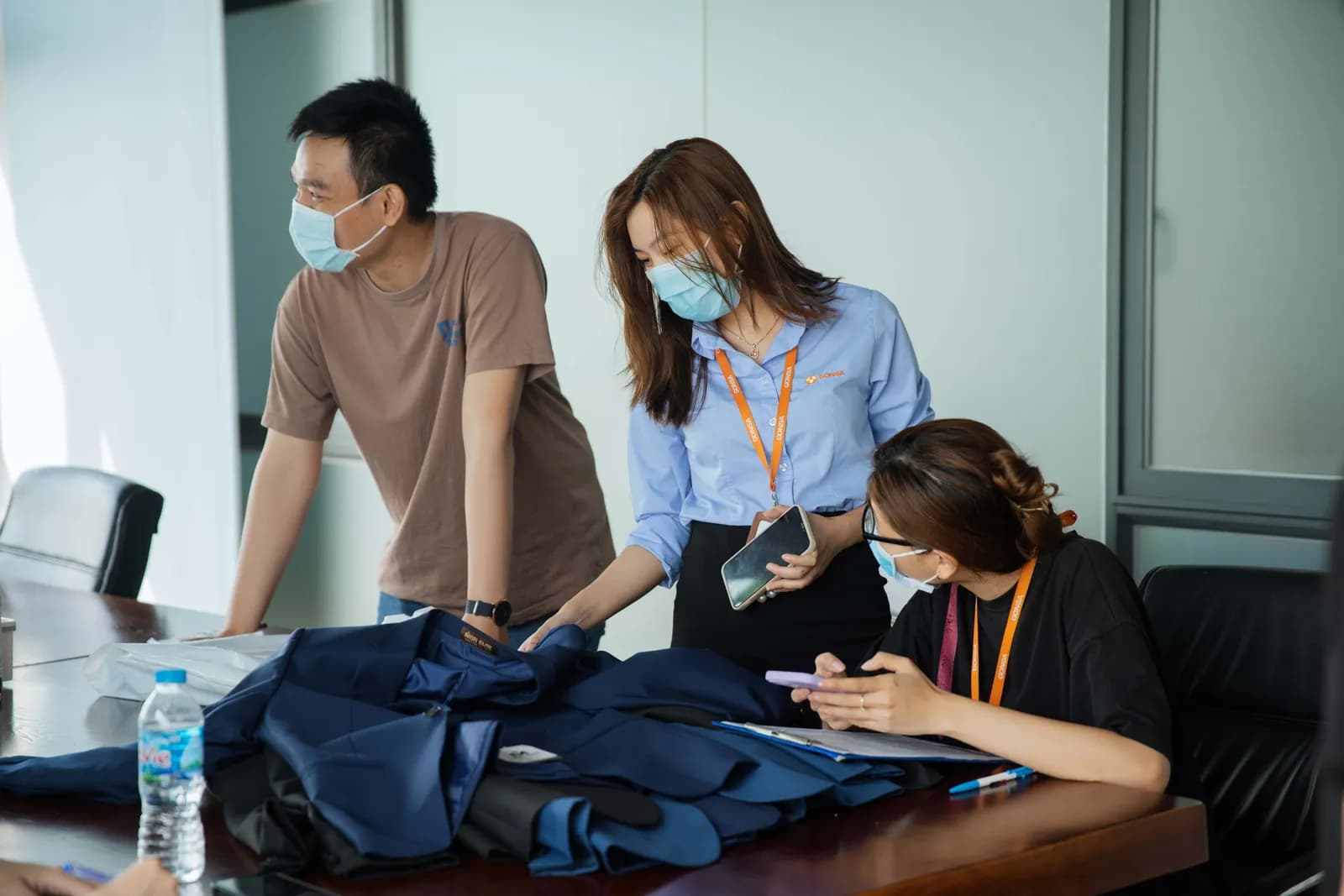
You can see men's office suits on our men's office suit page. Mon Amie Uniform has worked with Tập đoàn Gonsa; the photo below shows one of our projects.

Fabric: durable, low-crease, quick to recover
People who climb in and out of vehicles crease a garment faster than desk staff, so fabric should resist creasing and recover quickly. Real swatches are shown at the design stage.
| Fabric family | Strengths | Watch out for | Suits |
|---|---|---|---|
| Polyester-viscose with spandex | Holds shape, light stretch, low-crease | Press on medium heat | Suits and trousers for dispatch and managers |
| Wool-polyester blend | Fine surface, breathable, recovers well | Needs more careful care | Executives, sales |
| Cotton piqué | Absorbent, hard-wearing | Soft structure, not for jackets | Polos for warehouse and delivery crews |
Workwear for warehouse and delivery crews
Most people in a logistics company work in the field, so their uniform should be separate from the suit. Our page on security and technical uniforms shows the industry-uniform group: neat, durable styles for hands-on work. T-shirts and polos start from 150,000 VND, minimum 30; industry uniforms from 300,000 VND, minimum 20.
Our design library is a place to compare styles and colour pairings first.
Starting prices for planning
Mon Amie publishes starting prices by category. Real prices depend on fabric, style and quantity. Full details are on our pricing page.
| Item | From | Minimum quantity |
|---|---|---|
| Men's office suit | 3,000,000 VND | 5 |
| Women's office suit | 1,500,000 VND | 5 |
| Waistcoat | 600,000 VND | 5 |
| Men's shirt | 600,000 VND | 20 |
| Women's shirt | 480,000 VND | 20 |
| Trousers and skirts | 600,000 VND | 20 |
| T-shirts and polos | 150,000 VND | 30 |
| Industry uniform | 300,000 VND | 20 |
Each starting price is the entry level for that item alone; a formal proposal follows the on-site survey.
Measuring and ordering for a company that runs shifts
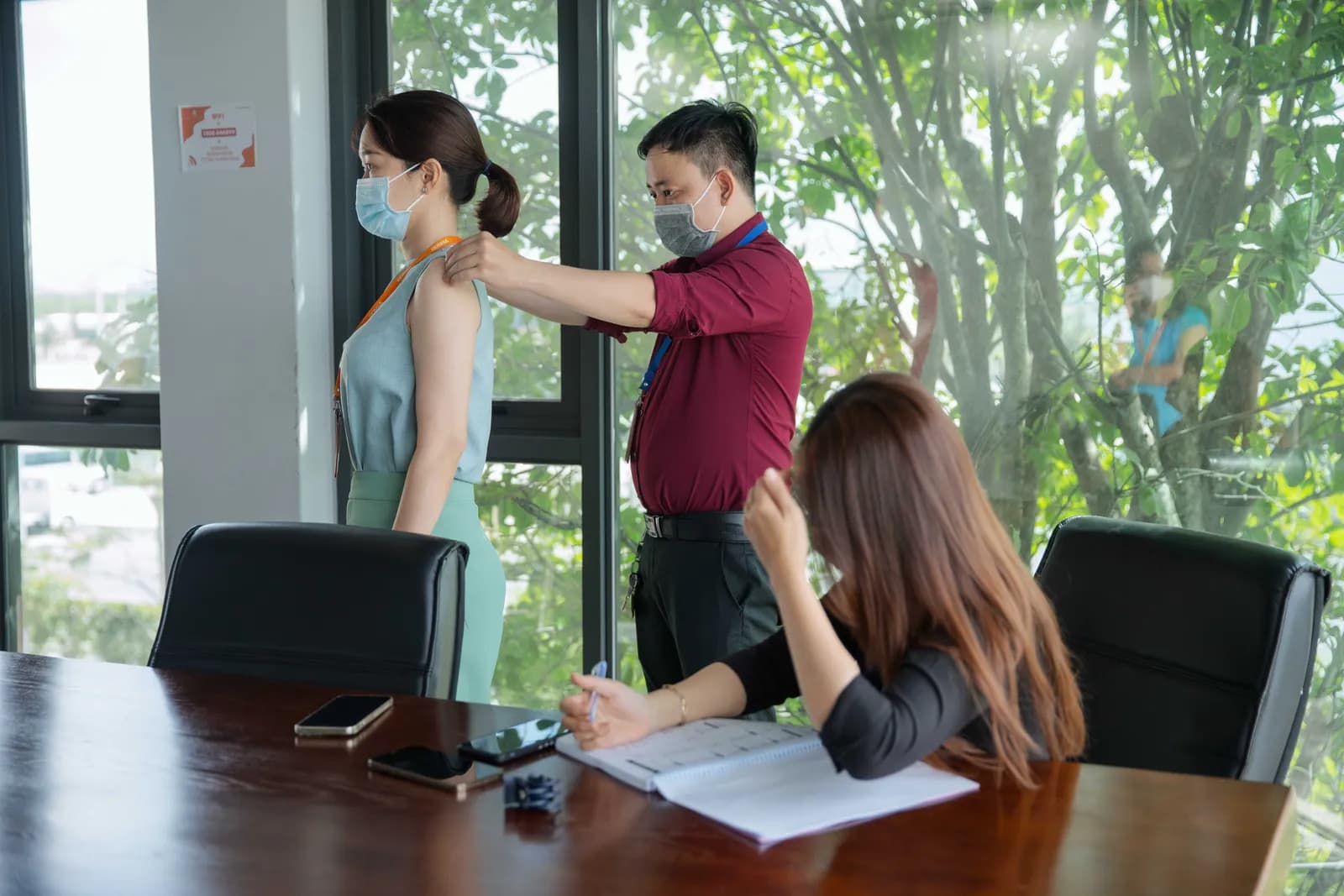
Logistics companies often work in several shifts, so the measuring plan needs flexibility. Mon Amie's mobile team measures each employee on site on your schedule, including outside office hours. Measurements of people already measured are stored under employee IDs for later orders; when the company hires, new staff are measured individually and made from the approved sample.
Hoàng Vy – Mon Amie was founded in 1991, and our 1,000 m² workshop on 3/2 Street has more than 80 skilled tailors. The process covers a survey, three design options, an approved sample, measuring, production with quality checks at three stages (cutting, assembly, finishing), then delivery on site. Allow 4–6 weeks after sample approval; alterations are covered by a free 3-year warranty at every showroom.
To receive a proposal with a price range for your company, submit your details on our quote page or call 0888.111.118 (the same number on Zalo). Mon Amie will schedule a survey at your premises and send a proposal with a price range based on quantity and fabrics.
Frequently asked questions
Do warehouse staff need to wear suits?
Usually not. Suits are for office, sales, dispatch and management teams; warehouse and delivery crews suit polos, T-shirts or durable industry uniforms. Both groups share one brand colour so the company still looks aligned.
What colour suits work for a logistics company?
Dark tones such as navy or charcoal hide dust and oil, which suits people who enter the depot often. The brand colour can appear in ties, scarves, an embroidered logo or the polos worn by the warehouse team.
What is the minimum order?
Suit jackets and waistcoats start at 5 pieces; shirts, trousers and skirts at 20; T-shirts and polos at 30.
Should a depot dispatcher wear a suit jacket or a waistcoat?
For roles that enter the depot often, climb in and out of vehicles, bend and reach, a waistcoat over a shirt is a leaner layer that is easier to put on and take off than a two-piece jacket. A jacket suits management and sales teams who meet customers. Mon Amie advises on the real rhythm of each role during the survey.