A bulge at the shoulder of a jacket can come from two sides: the wearer's shoulders and posture, or the shoulder slope, padding and sleeve set of the garment. A simple way to tell is to check whether the fault appears in every jacket that person has worn or in only one. Repeating across jackets suggests the tailor should take note of the shoulder shape when measuring; a fault in a single jacket usually lies in that jacket.
What a "bulge" looks like
Tailors use the word for three different effects, and each hints at a different cause:
- A ridge at the shoulder tip: from the side, the shoulder line rises into a step, and the jacket tip sits higher than the wearer's own.
- Diagonal folds from neck to shoulder: often with the collar lifting away from the shirt, as if the jacket were being pulled to one side.
- Excess at the shoulder tip: the pad pushes out beyond the real shoulder, so the jacket seems to sit on the shoulders rather than on the body.
Causes in the wearer
A jacket is cut to a standard shoulder and then adjusted to the person, so any departure from the standard shows up:
- Sloping shoulders: a standard pad and shoulder line lift the tip higher than the real shoulder, producing a ridge.
- Square shoulders: the reverse, where the jacket slopes more than the shoulder and pulls diagonal folds from the neck.
- Uneven shoulders: the higher side tends to bulge more.
- Posture: long hours at a computer curve the back and push the shoulders forward; carrying a bag on one side can tilt the shoulders over time.
Causes in the making
On the same shoulders, one jacket lies flat while another bulges. The usual points of failure are:
- A shoulder slope in the pattern that does not suit the wearer.
- A shoulder seam too long or too short against the real shoulder.
- A pad that is too thick or off-centre.
- A sleeve head set crookedly, or stiffened too much.
| Sign | Often the wearer | Often the making |
|---|---|---|
| Ridge at the shoulder tip | Shoulders slope more than the standard pattern | Thick pad; shoulder longer than the real one |
| Diagonal folds from neck | Square or forward-set shoulders | Shoulder slope cut too shallow; collar set off |
| One side bulges more | Uneven shoulders; bag carried on one side | Pads uneven between sides |
| Only one jacket does it | Unlikely | The pattern or sleeve set of that jacket |
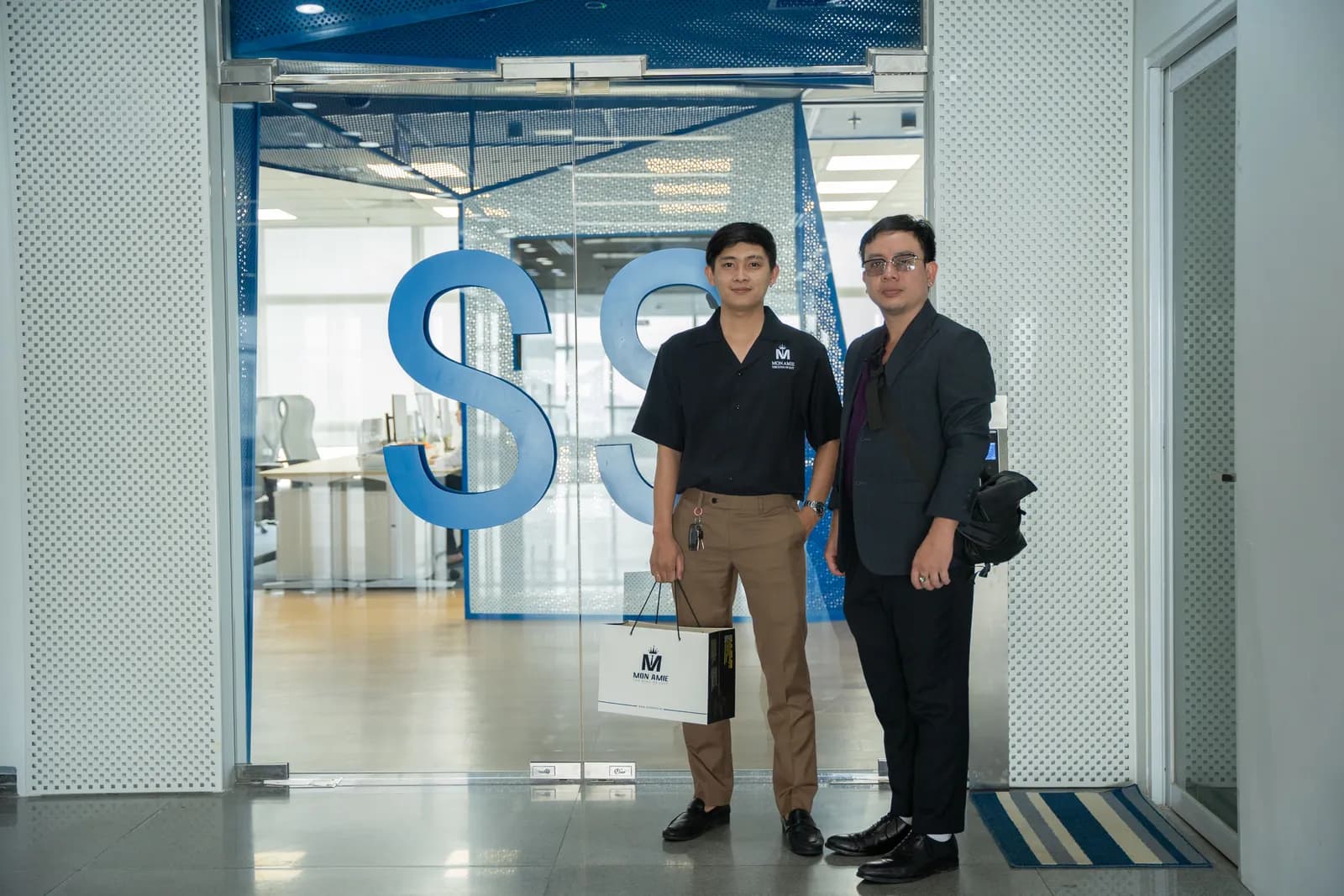
The photo below comes from a Mon Amie Uniform project with Á Đông Land.

A few minutes in front of a mirror
Work through these in order, ideally with someone taking photos:
- Stand straight with arms relaxed and face the mirror: do the jacket's shoulder tips meet your own?
- Turn sideways: the shoulder seam should sit on the crest of the shoulder, not drifting forward or back.
- Raise your arm and lower it: do the folds disappear or stay?
- Sit and reach for something: does the bulge get worse?
- Take a photo from behind to compare both sides.
The result lets you describe the problem precisely to your tailor, for instance "the left side rises when I lift my arm", rather than just "the shoulder is wrong".
For uniforms worn by many people: measure each person and try the sample
When a whole team wears one design, shoulders differ widely, so measuring each person individually is what lets the shoulder fit properly. In Mon Amie's process, a sample is made and production begins only when your company signs it off; each employee is measured individually at the office, and people who join later get their own measurements and are made to the approved pattern. At delivery the garments are tried on and adjusted on site, followed by free alteration warranty for 3 years at every showroom.
The shoulder is far harder to adjust than a sleeve length or trouser hem, because a change there tends to affect the collar and sleeve. Raise major concerns at the sample fitting rather than waiting for delivery. Tell the tailor if your shoulders are uneven or you carry a bag on one side.
Our design library and fabric library are good places to start. To request a quotation, use our quote page or call 0888.111.118 (the same number on Zalo).
Frequently asked questions
Can a bulging shoulder be corrected?
Minor cases, such as pad thickness or the smoothness of the sleeve head, can often be adjusted. When the cause is shoulder slope or width, it is much harder, so spot it at the sample fitting.
Should sloping shoulders have a thick or thin pad?
A thin or moderate pad is usually the safer choice, so the jacket tip is not pushed higher than the real shoulder. The final call should rest on trying the sample, not on a general rule.
Does a bulge mean I bought the wrong size?
It can, if the jacket's shoulder is longer than yours and extends past the tip. But a jacket of the right size may still bulge if the pattern's shoulder slope does not suit you. Run the checks above.
My left shoulder is higher than my right: can a made-to-measure jacket cope?
Uneven shoulders are quite common, so tell the tailor at the start of measuring. How to handle it, such as adjusting the pad on each side, is something the tailor will discuss during measuring and fitting.