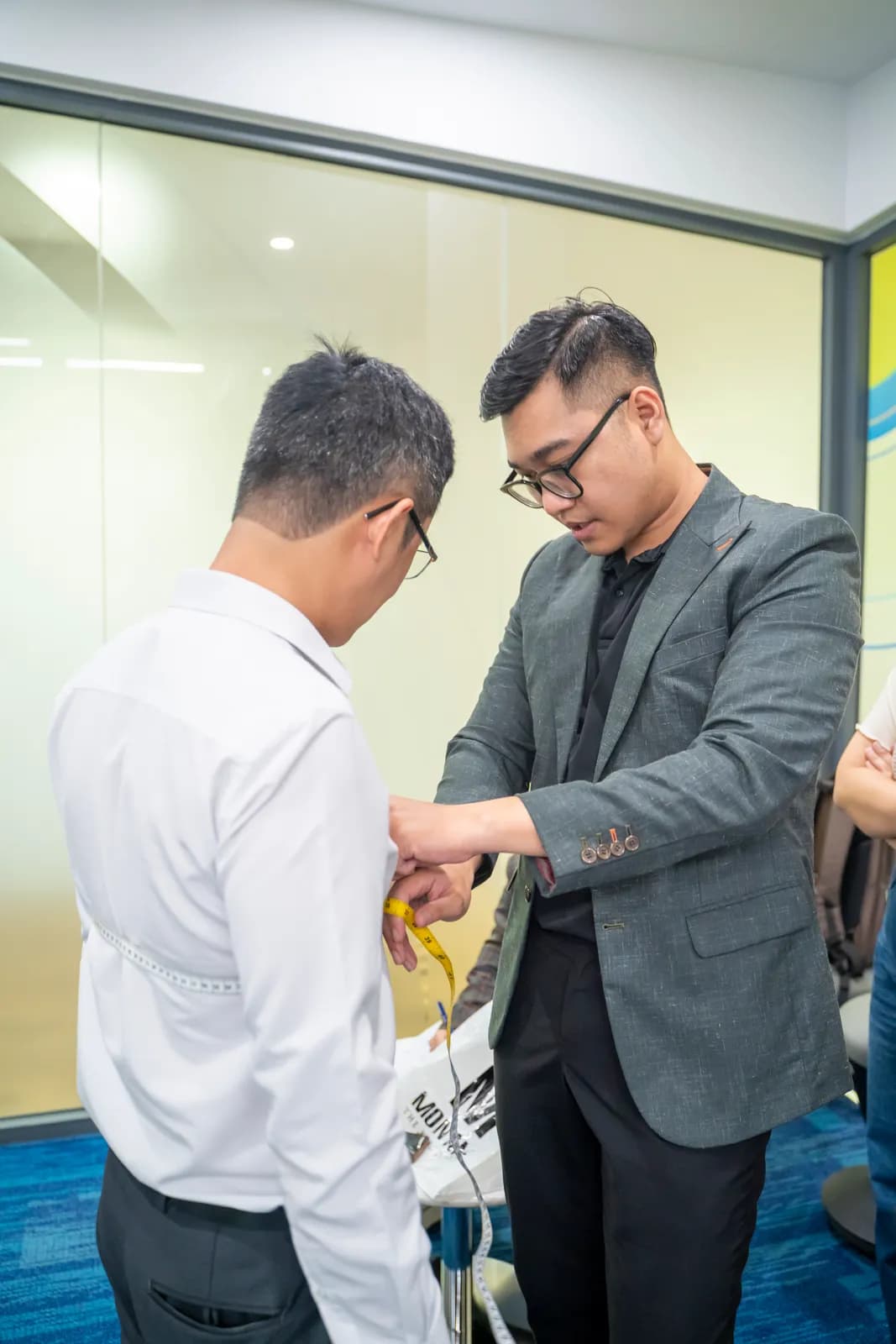
Suit-making terms fall into five groups: lapels and buttons, shoulders and waist, internal construction, vents and pockets, and trousers. Once you know the words below, you can read a workshop's proposal and ask the right questions instead of comparing prices alone. Workshops may use different names for a few ideas, so Vietnamese equivalents appear in brackets for cross-checking.
How to read one line of specification
Imagine a purchasing team receives a proposal that says: "2-button, notch lapel, natural shoulder, double vent, half-lined, fused". Without the vocabulary, it reads as a string of jargon; in fact each phrase is a decision about shape, breathability and price. The sections below explain the groups in the order you meet them when you look at a sample.
Lapels and buttons
- Notch lapel (ve bẻ): a V-shaped notch between collar and lapel; commonly used for business suits.
- Peak lapel (ve nhọn): the point of the lapel rises toward the shoulder; more formal and often seen on double-breasted jackets.
- Shawl lapel (ve lụa): a smoothly rounded lapel without a notch; often seen on dinner jackets and tuxedos.
- Button count (1, 2, 3): a single-breasted jacket usually has two or three buttons; the fastening point affects how much of the chest is open.
- Notation 6x2, 4x2: used for double-breasted jackets; the first number is the total buttons and the second is the number that fasten.
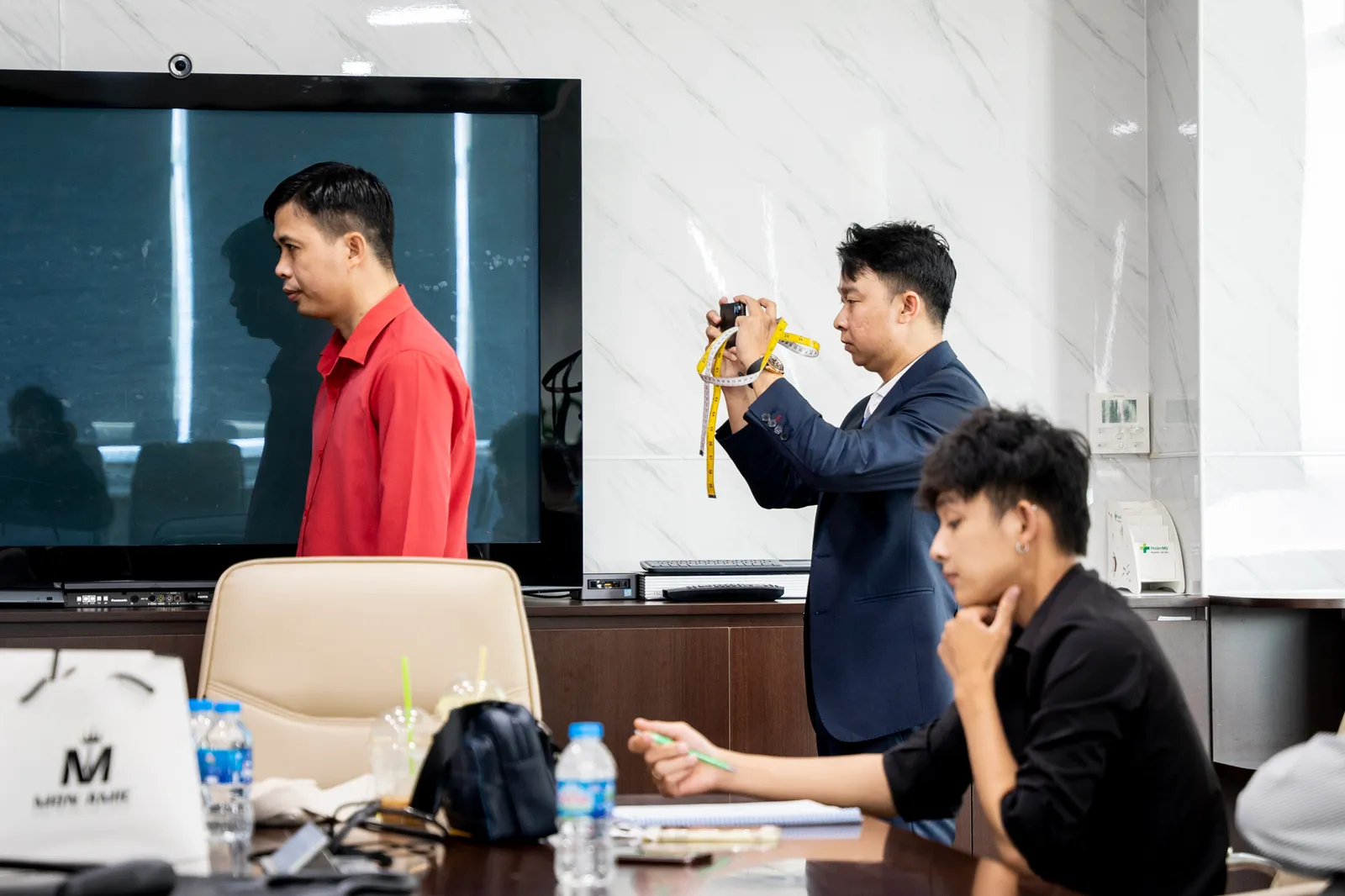
The photo below shows one of Mon Amie Uniform's projects.
Shoulders, body and waist
- Natural shoulder (vai tự nhiên): a soft shoulder line with little padding, light and comfortable.
- Structured shoulder (vai độn): padded to give a straight, firm line.
- Waist suppression (chiết eo): how much the jacket is taken in at the waist; more makes it closer, less makes it roomier.
- Fit (slim fit, regular fit): describes the general closeness of a style, not an individual size.
Inside the jacket: what customers rarely see
- Interlining (cốt vest, mex): the stiffening layer that shapes the chest and lapel; some workshops call it "mex".
- Fused and canvassed: a canvassed jacket has a separately sewn canvas layer and is usually described as softer and better at keeping its shape, though it takes more labour; a fused jacket is typically lighter and easier to make in volume. Which suits you depends on cloth, budget and how hard the jacket is worn.
- Full lining and half lining: half lining is usually more breathable, while full lining makes the jacket slide on easily and look tidy inside.
Vents, pockets and trousers
| Detail | Common styles | Note |
|---|---|---|
| Vent (xẻ lưng) | No vent, centre vent, double vent | Vents make it easier to sit, walk and put a hand in a pocket; double vents are often chosen by people who move a lot |
| Jacket pockets | Flap, jetted, patch | Flap pockets suit business wear; jetted pockets are slim and formal; patch pockets are sewn on and relaxed |
| Trouser pleats | Flat front, single pleat, double pleat | Pleats add room at hip and thigh; flat fronts look cleaner |
| Trouser hem | Plain hem, cuffed hem | A cuff folds up outside and is often used for a classic look |
If your management team includes foreign colleagues, the English terms above also make discussions with a workshop easier.
Five questions to ask when you receive a proposal
- Which lapel, shoulder and interlining are proposed, and why do they suit each wearer group?
- What fibres make up the fabric, how heavy is it, and is it suitable for hot, humid weather?
- When is the sample approved, and must the company sign it off before production?
- How are each person's measurements stored for later orders?
- Where are alterations handled after delivery?
With Mon Amie, the last three are answered as follows: production begins only after your company signs off the sample; measurements are stored under employee IDs, with new staff measured individually and made to the approved pattern; and alterations are covered by a free 3-year warranty at every showroom. You can browse styles in our design library and learn how fittings work on the on-site tailoring page.
Men's business suits start from 3,000,000 VND, with a minimum of 5 sets; fabric and style are among the factors that change the price. You can request a quotation on our quote page or call 0888.111.118 (the same number on Zalo).
Frequently asked questions
What is the difference between notch and peak lapels?
A notch lapel has a V-shaped notch and is the usual choice for business suits. A peak lapel points up toward the shoulder, looks more formal and often appears on double-breasted jackets. The choice depends on style and occasion.
How do canvassed and fused jackets differ?
A canvassed jacket has a separately sewn layer inside and is usually described as softer and longer-lasting in shape, though it takes more labour. A fused jacket is lighter and easier to produce in volume. Either can be right, depending on fabric, budget and how hard it is worn.
Should I choose a single vent or double vent?
A double vent is often practical for people who sit, walk and put their hands in pockets a lot. A centre vent is the familiar choice; no vent gives the cleanest line but less ease. Try them on the approved sample.
What do men's business suits cost, and what is the minimum order?
Men's business suits start from 3,000,000 VND, with a minimum of 5 sets. Real prices depend on fabric, style and quantity, so Mon Amie quotes specifically during consultation.