Designing uniforms from brand identity: from colour code to cloth
Designing uniforms from your brand identity: translate colour codes and logos onto real fabric, compare three options and sign off a sample before production.

Designing a uniform from a brand identity means turning colour codes, logos and typefaces on paper into fabric colour, embroidery and a cut that can be worn all day. The difficulty lies in colour: the same code can look different on a screen, on printed paper and on cloth. That is why you need real swatches and a signed-off sample before production.
What to bring to the first survey
Picture a brand whose bright orange looks striking on its website. On a polo shirt that orange may turn harsh or dull, depending on the cloth and the light. To avoid surprises, bring the following to the first survey, which is step one of Mon Amie's process and ends with a proposal and price range:
- Vector logo files (AI, PDF or SVG), including light and dark versions.
- The colour specification (Pantone, CMYK or RGB, if you have it).
- Brand typefaces and logo usage guidelines.
- A few real printed items, such as business cards, brochures or signage, to compare colour against.
- A list of the groups who will wear the uniform and the conditions each works in.
From colour code to cloth: why screens mislead
A screen emits light, paper takes ink, and cloth is dyed and has a surface of its own. Cotton, polyester and blends absorb and reflect light differently, so one colour code yields different results. Dyed fabric from separate lots may also differ slightly in shade, so an approved sample should be kept as the reference for later orders.
The reliable method is to put a real swatch beside your brand collateral and look at it under the lighting of your workplace. At the design stage, Mon Amie presents three options in your brand colours with real swatches. You can browse the fabric groups in our fabric library beforehand.
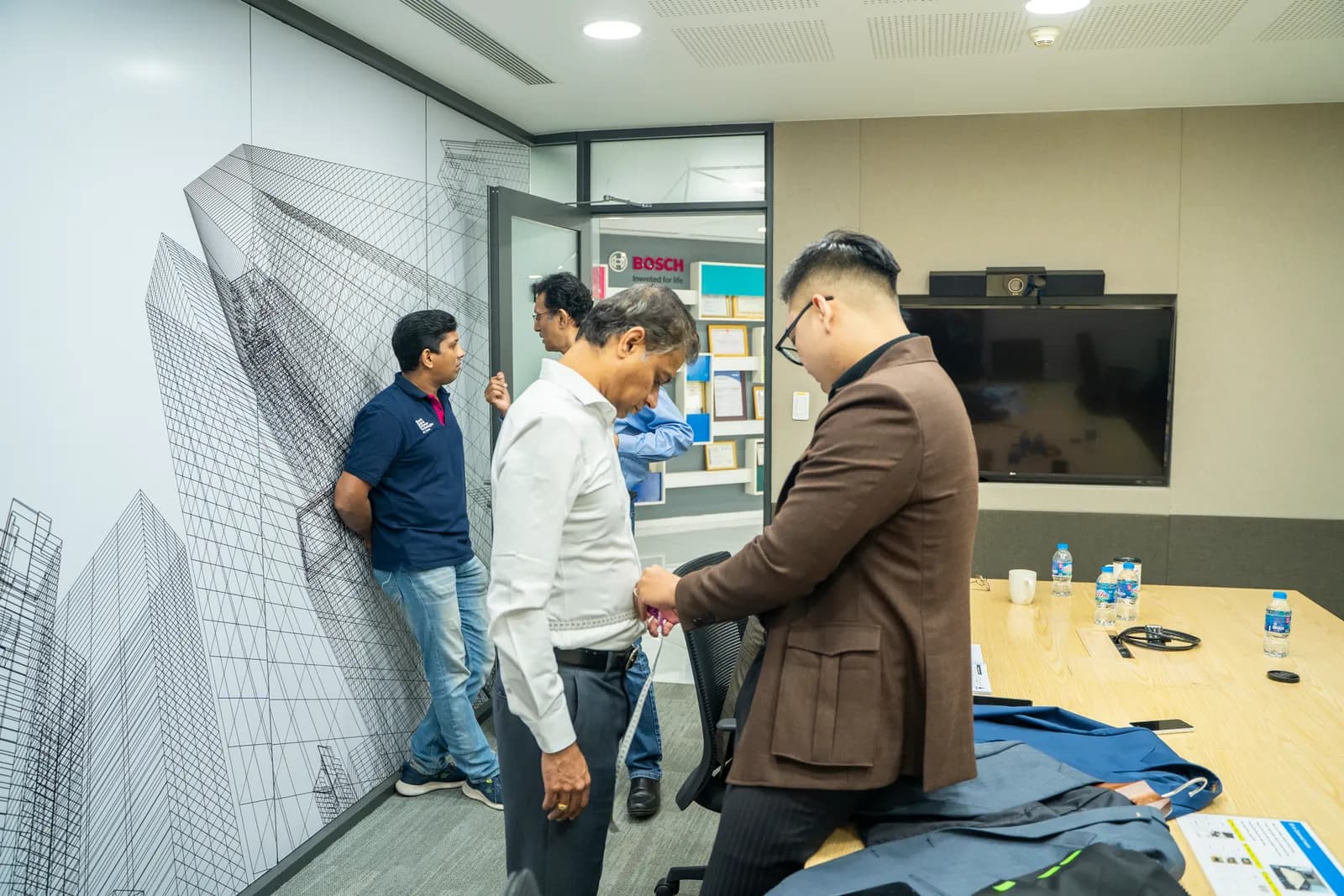
To see how Mon Amie Uniform works with an organisation, here is a project with Viện Phát triển Nguồn nhân lực và Kinh doanh — UEH.

Placing the logo and other identity elements
A brand identity has many elements, and none should be crammed onto a single garment. The table suggests how each can be carried across, depending on the individual design.
| Identity element | How it appears on a uniform | Note |
|---|---|---|
| Logo | Embroidered or printed on the left chest, sometimes the sleeve | Check on the chosen cloth and with buttons fastened |
| Main colour | Main fabric colour, or collar and cuff trim | Avoid too many colours at once |
| Secondary colour | Tie, scarf, bow tie | Keep it sparing so the look stays clean |
| Name and job title | Embroidered or on a badge | Use a typeface close to the identity |
| Tagline | Use sparingly | Small text is hard to read at a distance |
Comparing three options by criteria
With three options side by side, it is easy to choose by gut feeling. Score them against these criteria and ask the people who will wear them:
- Recognisable as your brand from a few metres away.
- Comfortable over many hours of standing, sitting and moving.
- Easy to launder and colour-stable, which you can check by test-washing the sample.
- Suited to roles: managers can add a jacket or waistcoat in the same colour family to set them apart.
- Photographs well at events and in recruitment images.
For ideas on cuts, see our design library.
Approving the sample and staying consistent
Once an option is chosen, a sample is made and production starts only when your company signs it off. Each employee is measured individually at the office. People who join later are measured individually and made to the approved pattern; measurements already taken stay on file under employee IDs, so every order keeps to the same sample.
The six-step process and its 4–6 week timeline after sample approval are set out on our process page. Pricing depends on fabric, style and quantity. You can send your brand guidelines through our quote page or call 0888.111.118 (the same number on Zalo) for advice.
Frequently asked questions
Which files are needed to design a uniform from our identity?
Ideally vector logo files, the colour specification, brand typefaces and a few real printed items for colour comparison. If you lack some of these, bring what you have to the survey and discuss it there.
What if the screen colour differs from the cloth colour?
Do not approve colour on a screen. Compare a real swatch with your printed brand items under your workplace lighting, then approve on the sample garment. Mon Amie provides real swatches at the design stage.
Should the logo be embroidered or printed?
Embroidery generally holds up better to heavy washing, while print gives a flatter surface. The choice depends on the cloth and the design, so check the logo directly on the sample, including with buttons fastened or a badge worn.
How do we keep colours consistent across several branches?
Use the signed-off sample as the standard for every order. Staff at other branches are measured individually and made to the same pattern, with measurements stored under employee IDs.