Budgeting uniforms for power and energy companies, per employee
How to budget uniforms for power and energy companies per employee: group engineers and office staff, use starting prices as a guide, then request a quotation.

A uniform budget for a power or energy company works well when it is built person by person: divide employees into groups, decide which items each group needs and how many pieces, then multiply by the real unit prices in a quotation. Published starting prices are only an entry point for each item. They show which costs fall within reach, but they are not the figures to submit for approval.
Step 1: group the wearers
The two common groups are engineers and office staff. Engineers work in the office, attend meetings and meet partners, and also go out to sites; office staff include administration, accounting and HR. Protective workwear for sites follows each organisation's own safety rules, so keep it as a separate budget line rather than folding it into image uniforms.
| Group | Items often considered |
|---|---|
| Engineers | Shirts, trousers; polos for lighter days; jacket or waistcoat for meetings and partners |
| Office staff | Shirts, trousers or skirts; women's jackets for managers |
| Managers, executives | Jackets, waistcoats, accessories |
Our page on corporate and office uniforms shows how such teams are commonly dressed.
Step 2: decide pieces per person and review cycle
Pieces per person and the review cycle are the company's decision. At this step you count quantities only; do not multiply prices yet. Suppose an organisation has 40 engineers who each receive 2 shirts and 2 pairs of trousers: that is 80 shirts and 80 pairs of trousers, both above the 20-piece minimum for the item. This is an illustration to show the method, not a real project.
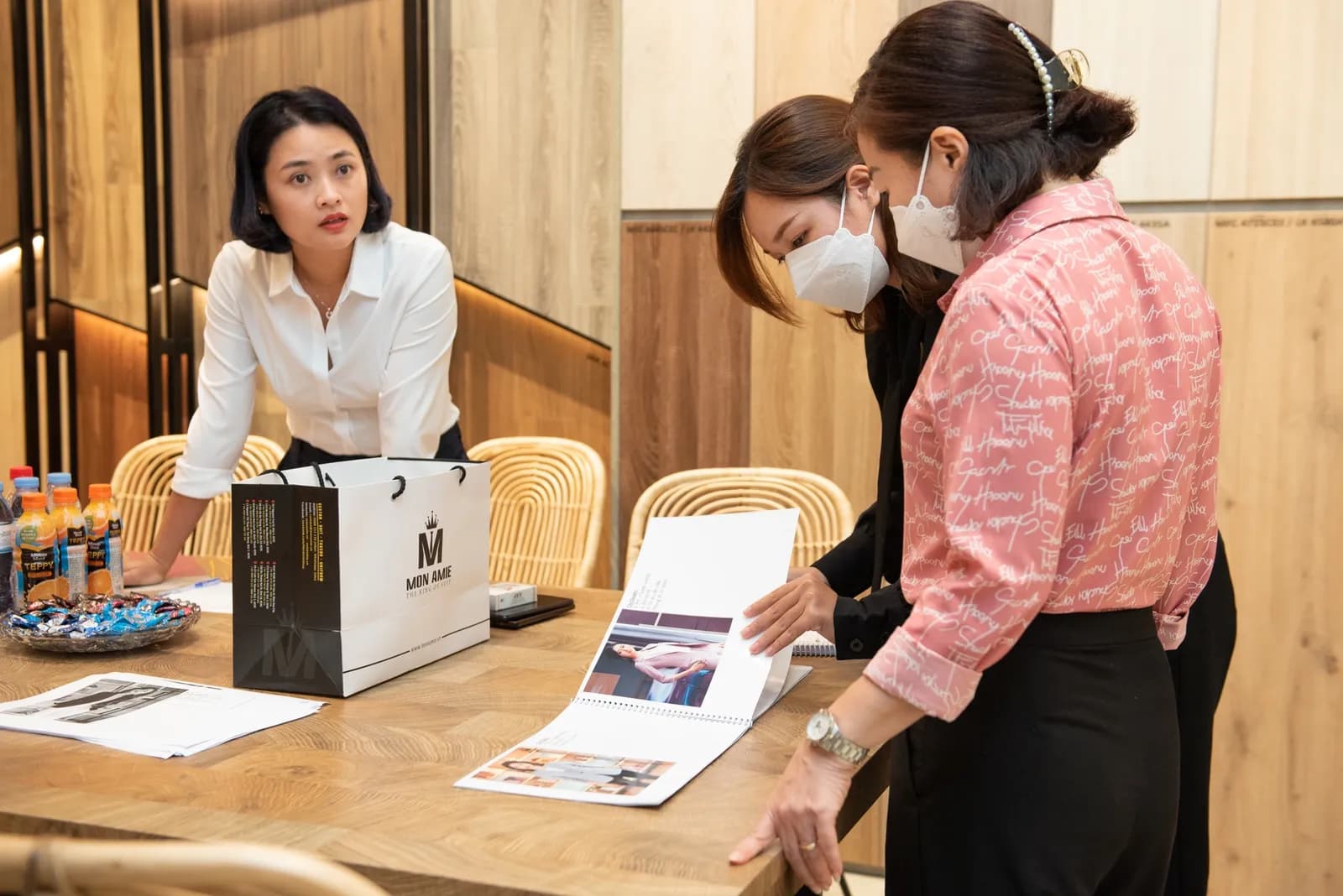
This photo comes from a Mon Amie Uniform project with PV Power – Ban QLDA Điện.

Step 3: use starting prices as a guide, not an approval figure
This table shows the starting prices and minimum quantities Mon Amie publishes for each item:
| Item | From | Minimum quantity |
|---|---|---|
| Men's business suits | 3,000,000 VND | 5 sets |
| Women's business suits | 1,500,000 VND | 5 sets |
| Waistcoat | 600,000 VND | 5 |
| Men's shirt | 600,000 VND | 20 |
| Women's shirt | 480,000 VND | 20 |
| Trousers and skirts | 600,000 VND | 20 |
| T-shirts and polos | 150,000 VND | 30 |
| Accessories (ties, scarves, etc.) | 150,000 VND | 20 |
Each line is the starting price of that category alone. Do not add the lines into a full-set price, and do not multiply a starting price by headcount and treat the result as the official budget, because real prices depend on fabric, style and quantity. Material and design both affect the real price, so look at swatches in our fabric library before deciding. In practice, build a sheet with columns for group, item, headcount and pieces per person, then enter the unit prices from the quotation.
Step 4: keep a line for new hires and top-ups
Most years some people join and others change roles, so keep a separate budget line for top-ups. New hires are measured individually and made to the approved pattern, while people already measured have measurements stored under employee IDs and need no re-measuring. Because every item has a minimum quantity, grouping top-up needs into batches is usually easier to plan than ordering one by one.
Common budgeting mistakes
- Treating a starting price as a set price. It is the entry point for one item; the final figure sits in the quotation.
- Forgetting accessories such as ties and scarves, which have their own minimum.
- Folding protective workwear into uniforms, which skews the numbers.
- Choosing fabric after the budget is approved, even though fabric directly affects the unit price.
- Comparing purchase price only, ignoring durability.
From a rough budget to a quotation
A survey at your premises ends with a proposal that includes a price range, and after sample approval measuring, making and delivery take 4–6 weeks. The full sequence is on our six-step process page. Once you have a sheet of headcount and items, bring it to our quote page or call 0888.111.118 to get real unit prices.
Frequently asked questions
Should uniform budgets be calculated per set or per person?
Per person, then annualised: decide which items each person needs, how many pieces of each, and multiply by the unit prices in a quotation. This makes it easy to see which lines move when headcount changes.
Can starting prices be used to prepare a budget for management?
As a rough guide to which items are within reach, yes. The official figure should come from the quotation after a survey, because real prices depend on fabric, style and quantity.
Should site protective workwear be part of the uniform budget?
Keep it as a separate line, since it follows each organisation's safety rules. You can discuss your specific needs with Mon Amie during the survey.
How do we budget for employees who join mid-year?
Set aside a top-up line. New people are measured individually and made to the approved pattern, and it helps to group them into batches because every item has a minimum quantity.