Work colours for women by skin tone: how to choose and test
Choose work colours by skin tone: find your warm, cool or neutral undertone, then test shades beside your face. Mon Amie shows how, including for team uniforms.
To choose work colours for women by skin tone, work out whether your undertone is warm, cool or neutral, then test shades right beside your face in daylight, rather than judging by how light or deep your skin is. The colour at the neckline affects your face more than the colour of the whole garment. For a team uniform worn by everyone, the approach changes: pick a neutral base and let the colour closest to the face vary by person.
Start with undertone, not depth of skin
Picture an office of twenty women all in the same pure white shirt. Some look radiant and some look washed out, though the shirt is identical. The difference lies in undertone, the pink, yellow or olive cast beneath the surface, rather than in whether skin is light or deep. Two women with equally fair skin can have a cool pink undertone and a warm golden one.
A few quick checks, offered as guidance only:
- Wrist veins: bluish or purplish tends to suggest cool; greenish tends to suggest warm; a mix often means neutral.
- Jewellery: if silver flatters you, the undertone is often cool; if gold does, often warm.
- Two sheets of paper: hold pure white and cream under your chin and see which brightens your face.
No single test is final; the mirror decides.
A guide to colours beside the face
| Undertone | Neckline colours that often work | Shades to test carefully |
|---|---|---|
| Cool (slightly pink or rosy) | Navy, steel grey, teal, pure white, cherry red | Mustard, burnt orange, yellowish cream |
| Warm (golden, peachy, olive) | Cream, beige, camel, moss green, brick red | Stark white beside the face, cool ash grey |
| Neutral | Most colours; deep blue, wine and green are all worth trying | Very pale shades that can flatten the face |
Depth matters as well. Fair skin often looks good in colours of moderate contrast. Deeper skin often suits saturated shades such as sapphire, wine or ivory rather than pale pastels, which can drain energy from the face. This is a general tendency, not a hard rule.
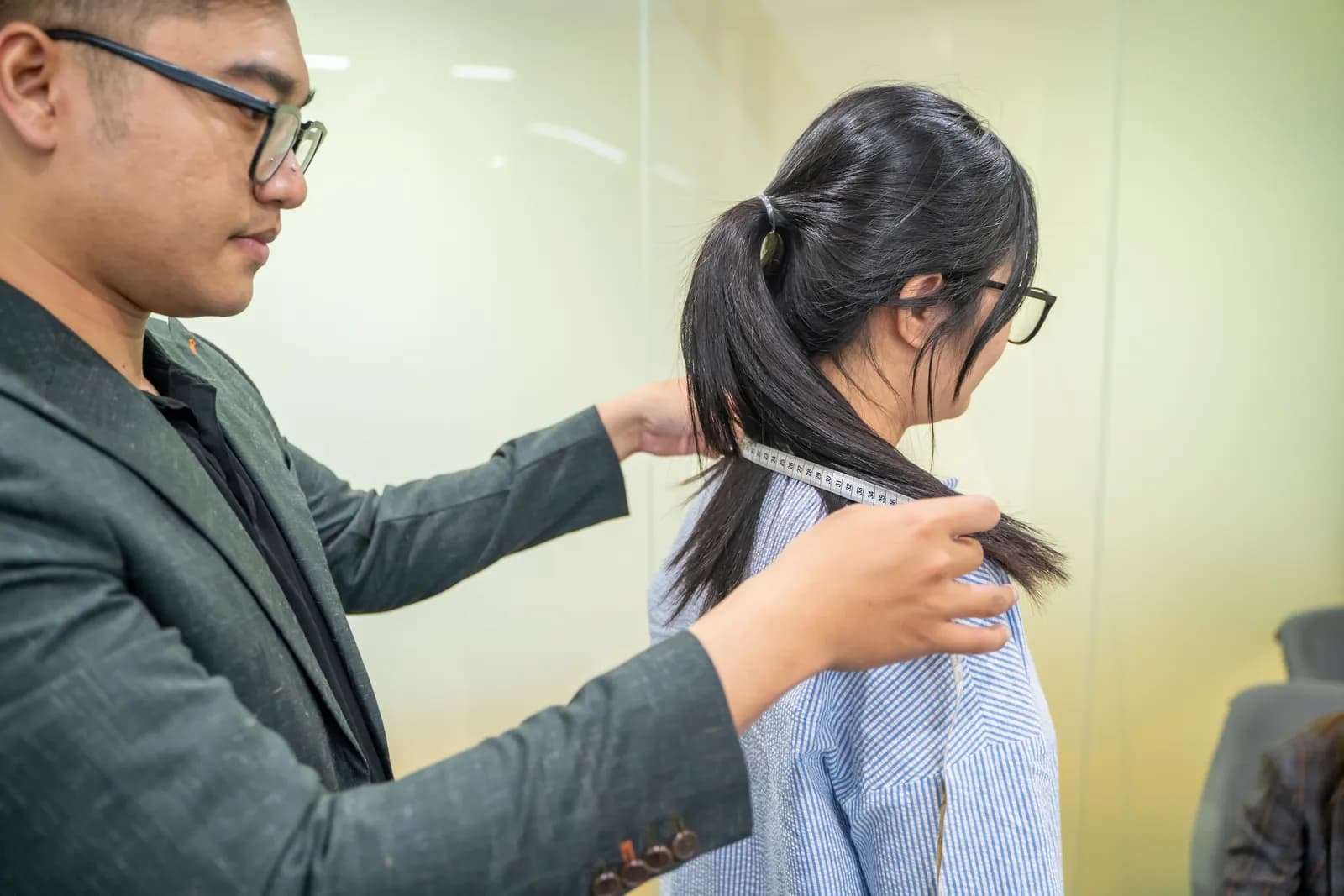
One of Mon Amie Uniform's projects is pictured below.

When the whole team wears one colour
A uniform poses a problem that personal advice cannot solve: one colour for many skin tones. Four things reduce the risk:
- A neutral base: navy or charcoal tends to suit many undertones and pairs easily with a brand colour.
- A sensible neckline: a V or modestly open neck lets the colour beside the face come from an inner layer or a scarf, not the whole garment.
- Let people choose accessories: offer two or three scarf colours. Mon Amie's accessories (scarves, ties and so on) start from 150,000 VND with a minimum of 20; real prices depend on fabric, style and quantity.
- Be cautious with stark white and bright yellow: both are unforgiving on many complexions, so choose them only after testing on several people.
You can browse fabric groups and colours in our fabric library.
Testing colour properly
Many colour decisions go wrong because the test conditions differ from real wear. We suggest:
- Test near a window in daylight, then again under the office lighting; fabric colour shifts noticeably between the two.
- Test with an everyday face, without heavy lipstick or powder.
- Hold swatches under the chin and compare two colours side by side rather than one at a time.
- Ask a colleague to look, as the mirror is easily skewed by habit.
- Test on several people at once, especially for uniforms, to see how many faces a colour suits.
From personal advice to a team uniform
At the design stage, Mon Amie presents three options in your brand colours with real fabric swatches. Your female staff can hold each swatch up to their faces, compare and give feedback before approval; production starts only after your company signs off the sample. Each person is then measured individually at your office. The whole sequence is on our six-step process page.
To try the swatches on your own team, start with a quotation request on our quote page or call 0888.111.118.
Frequently asked questions
How do I know if my skin tone is warm or cool?
Look at your wrist veins, compare silver with gold, or hold white and cream paper under your chin. These are guides only; the more reliable step is to try the colour on and look in a mirror in daylight.
Is white flattering on every skin tone?
Not always. Pure white often suits cool undertones but can make warm undertones look pale, while ivory or cream is usually easier. The surest method is to test the colour directly beside the face.
How can a single company colour suit every employee?
Choose a neutral base and leave the layer beside the face, such as a scarf or inner top, for each person to adjust. Mon Amie presents three options in your brand colours with real fabric swatches so you can test them on many faces.
Which colours are easy to wear across many skin tones at work?
Navy and charcoal are commonly chosen as base colours because they suit many undertones. Even so, each person should test beside the face, since the depth of the same colour also changes the result.