Cufflinks: when to wear them and when to skip them
Cufflinks only work with double-cuff shirts and suit formal occasions. When to wear them, how to match metals with a suit, and common mistakes to avoid.

Cufflinks only work with a double-cuff (French cuff) shirt, which has buttonholes on both edges of the cuff, and they belong to formal occasions: evening events, weddings, signings and important meetings in a suit. For ordinary working days a button-cuff shirt is neat and polite enough, and in places with a lot of hand contact, such as kitchens, building sites or treatment rooms, cufflinks are better left at home.
First condition: the cuff needs buttonholes
Many people buy cufflinks and only then discover that their shirt cannot take them. Check the cuff first:
| Cuff style | Feature | Cufflinks? |
|---|---|---|
| Double cuff (French cuff) | A long cuff folded back, buttonholes on both edges | Yes, this is the cuff made for cufflinks |
| Button cuff | One or two buttons on the cuff edge | No, unless the shirt also has buttonholes |
| Convertible cuff | Both a button and a buttonhole | Can be worn either way |
If your company wants a double cuff in its shirt design, raise it in consultation so the cuff style can be included at the design stage.
Occasions to wear them, to consider them, and to skip them
The simplest way is to sort by formality:
- Wear them: formal dinners, weddings, award ceremonies, signings and any event whose dress code says black tie or similar. A double-cuff shirt with a tuxedo or a dark suit is the familiar combination.
- Consider them: board meetings, large partner meetings and client conferences, when the wearer is in a properly fitted suit and a double-cuff shirt that suits the cut.
- Skip them: shifts that need busy hands, building sites, kitchens, treatment rooms, or anywhere cuffs catch on equipment and furniture. A hard link can snag, go missing or scratch things.
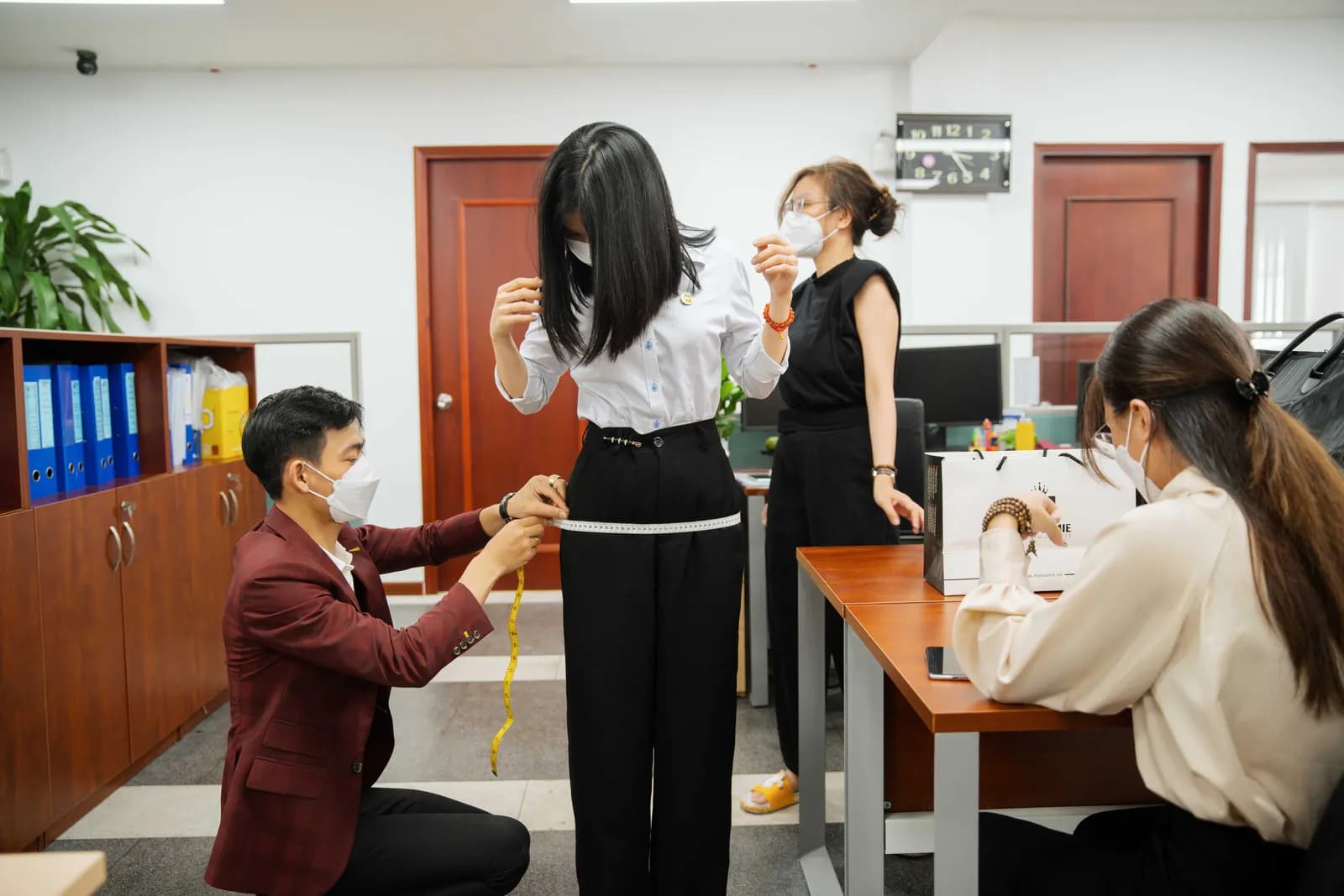
The photo below shows a Mon Amie Uniform project with Bệnh viện Hoàn Mỹ Sài Gòn, included only to show how we work with companies.

Choosing and matching: metal, style and size
- One metal tone: watch, belt buckle and tie bar should share a tone, silver with silver, gold with gold. The cufflinks need not match exactly, only avoid arguing with the rest.
- Style: bullet-back and whale-back fittings are easy to fasten; chain links are slimmer and more classic. Start with a plain design, because it pairs with many shirts.
- Moderate size: oversized links can catch on a jacket sleeve, while tiny ones look lost on a double cuff.
- Stone or enamel colour: keep it in the same family as the tie or pocket square, but do not copy it exactly.
- Cuff showing: when standing straight, the jacket sleeve should reveal about a centimetre to a centimetre and a half of shirt cuff, enough for the links to show as the arm moves.
Three common mistakes
- Forcing cufflinks onto a shirt with no buttonholes, using clips or threading through a button. This usually distorts the cuff and damages the shirt.
- A jacket sleeve that is too long, covering the shirt cuff so nobody sees the links. The cause is usually the sleeve measurement, not the cufflinks.
- Wearing them on the wrong day, for instance when the rest of the team is in polos and short sleeves. The simpler the clothing, the more out of place the links look.
Cufflinks in a company uniform
For most employees, cufflinks are unnecessary. They earn a place only with teams that have formal annual events: directors, event hosts or internal presenters. What matters then is not the link but the wrist: the double-cuff shirt must fit and the jacket sleeve must be the right length, so individual measurements come first.
The Mon Amie Uniform mobile team measures each employee at the office, and the six-step process from survey to delivery, with a free alteration warranty of 3 years at every showroom, is described separately. Ideas for cuff and shirt styles are in our design library. If your company wants cufflinks to reflect its identity, raise it during consultation so Mon Amie can respond with specifics; send your details through the quote page or call 0888.111.118 (the same number on Zalo).
Frequently asked questions
Can cufflinks be used with an ordinary button-cuff shirt?
Generally no, because cufflinks need a buttonhole on both edges of the cuff. If you want to use them, choose the right cuff style from the design stage.
Should I wear cufflinks to work every day?
It depends on company culture and role. In a formal office a plain pair with a double-cuff shirt is still appropriate. Where hands are busy, a button-cuff shirt is more practical.
How do cufflinks match a watch and belt?
Keep one metal tone across the links, belt buckle, tie bar and watch case. Matching the metal is enough; the pieces do not need to be a set.
How much shirt cuff should show below the jacket sleeve?
About a centimetre to a centimetre and a half when standing straight. That needs an accurate sleeve measurement for each person, so measuring each employee individually is the dependable way to get the length right.